


08 Aug Rabby Wallet, Multi-Chain Access, and the Real Value of Transaction Simulation
You are about to swap tokens on a new decentralized exchange, approve a contract, or move assets across several networks. The interface looks familiar, yet the transaction may still carry unfamiliar risks: an unexpected token approval, a transfer to the wrong address, an unfavorable route, or a fee that changes before confirmation. This is the practical problem a modern DeFi wallet must solve. Holding private keys is only the beginning; the harder task is helping users understand what a smart contract interaction is likely to do before it is signed.
Rabby Wallet is designed around that broader interpretation of a cryptocurrency wallet. Its multi-chain approach brings networks and decentralized applications into one browser-based workflow, while transaction simulation attempts to translate opaque contract calls into a more useful preview. Neither feature makes DeFi risk-free. Their value lies in reducing certain classes of error without pretending to eliminate uncertainty.
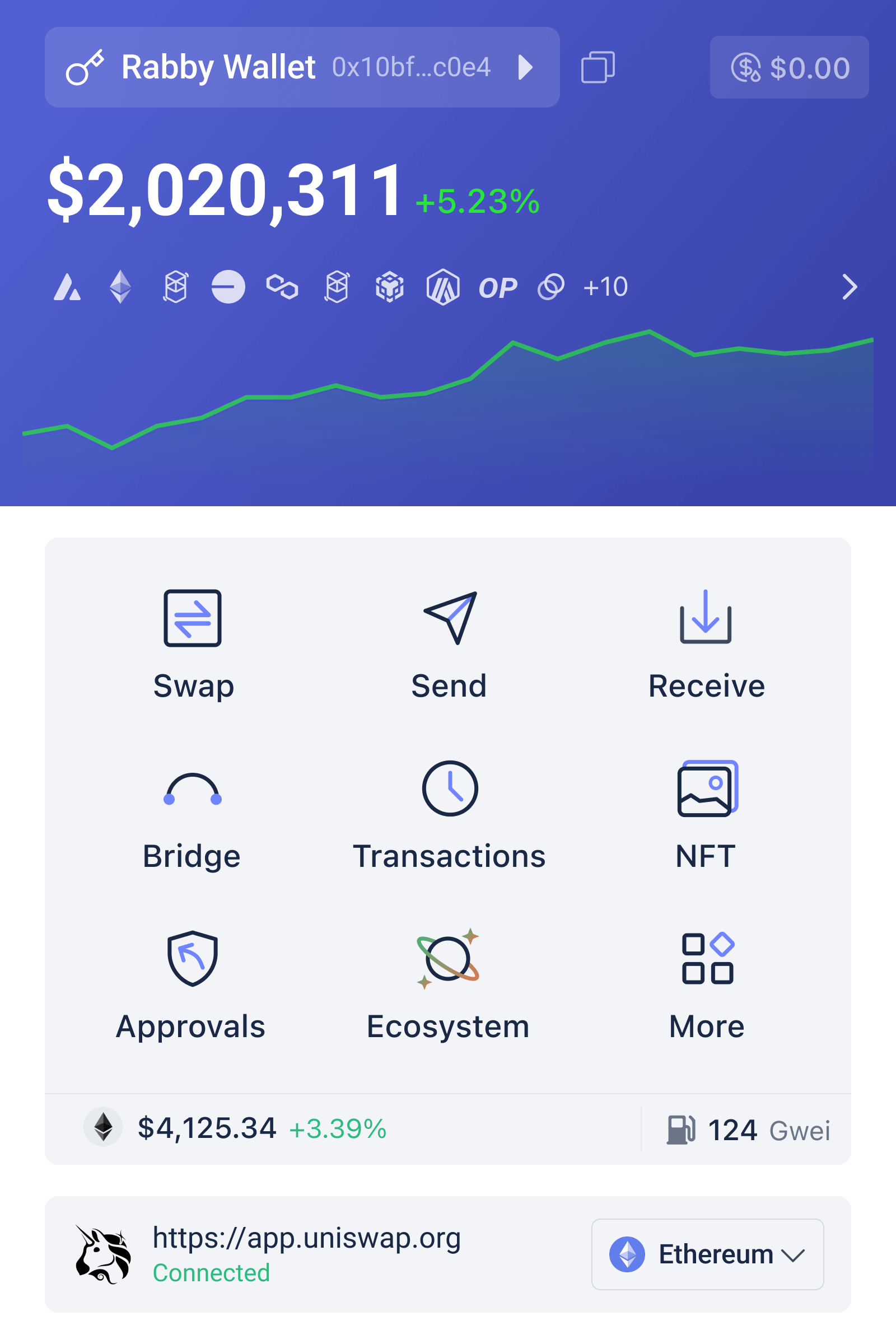
What a multi-chain wallet actually changes
A single-chain wallet mainly asks the user to manage one network’s addresses, assets, fees, and applications. A multi-chain wallet must coordinate several environments that may use different native assets, fee markets, contract deployments, and transaction conventions. The visible interface may look unified, but the underlying systems are not.
That distinction matters because “multi-chain” does not mean that one balance is automatically available everywhere. Assets represented on different networks may have different contract addresses, liquidity conditions, and bridge dependencies. A user can own a token on one network and still need a bridge, an exchange route, or a network-specific transaction to use it elsewhere. The wallet can simplify discovery and signing, but it cannot erase these settlement differences.
Rabby’s multi-chain design is therefore best understood as an organizational and decision-support layer. It can help users switch between supported networks, connect to decentralized applications, and inspect activity from a common wallet environment. The benefit is reduced context switching. The trade-off is that a single interface can make distinct networks feel more interchangeable than they really are.
For a US-based DeFi user, this is especially relevant when fees, liquidity, and application availability vary by network. A transaction that is inexpensive on one chain may be slower, more expensive, or less liquid on another. Before installing any browser wallet, users should verify the source, understand the recovery phrase model, and confirm which networks and applications they actually intend to use. Those seeking an installation path can review the rabby wallet extension while keeping the security checks separate from the convenience of the interface.
Why transaction simulation is more than a green check mark
A blockchain transaction is often represented to the user as a short technical request: interact with a contract, provide a value, and sign. That description is incomplete from a human perspective. The important question is not merely whether the transaction can be submitted, but what state changes it is expected to produce.
Transaction simulation addresses this gap by executing an approximation of the proposed call against a blockchain state or an available representation of that state before the user broadcasts it. The result may reveal expected token transfers, approvals, contract failures, or other effects. In conceptual terms, simulation converts a raw instruction into a forecast of state transition: which assets leave the wallet, which assets arrive, and which permissions may be granted.
This is a sharper mental model than treating simulation as a security scanner. A simulation does not prove that a contract is honest. It asks what the call appears to do under particular conditions. If the contract is upgradeable, depends on changing external data, or behaves differently according to block timing, the simulated result may not perfectly match the confirmed transaction.
Consider a token approval. The apparent action may be “approve a spender,” but the economically important consequence is a permission that can allow later transfers within the approved scope. A useful wallet preview can make that permission more visible than a conventional contract-data panel. The user still must decide whether the spender and allowance are appropriate. Simulation improves the information available at the decision point; it does not replace judgment.
Rabby Wallet versus a conventional wallet workflow
The most useful comparison is not between a “safe” wallet and an “unsafe” wallet. It is between a workflow that exposes more transaction context and one that leaves more interpretation to the user.
Conventional wallet workflow
Many wallets are intentionally general-purpose. They store keys, display balances, connect to applications, and ask the user to approve signed messages or transactions. This model can be reliable and lightweight, but the user may need separate tools to identify contract addresses, estimate outcomes, review approvals, or compare network context. The wallet performs signing; the user performs much of the analysis.
Rabby’s integrated workflow
Rabby emphasizes pre-signing interpretation, particularly for DeFi interactions across multiple networks. A user may receive a more contextual view of a proposed transaction, including expected asset movements or warnings associated with the call. This reduces the chance that a person signs purely because the request appears inside a familiar application.
The trade-off is complexity. More information is useful only if it is understandable and correctly interpreted. A warning can be dismissed too quickly, while a clean simulation can create false confidence. Users also need to distinguish between an application’s displayed intent and the wallet’s simulation of the resulting call. The two may diverge because interfaces can be misleading, contracts can be complex, and transaction parameters can be altered before signing.
| Consideration | Conventional wallet workflow | Rabby-style multi-chain workflow |
|---|---|---|
| Network management | Often requires more manual context switching | Designed to consolidate multi-network activity |
| Transaction understanding | May present mainly technical signing details | Attempts to show likely effects before signing |
| Risk reduction | Depends heavily on the user’s own inspection | Can expose certain mismatches and unexpected outcomes |
| Main limitation | Less integrated context | Simulation and warnings are not guarantees of safety |
Where transaction simulation can break down
The central limitation is that simulation is conditional. It reflects the contract’s behavior under a particular state, set of parameters, and execution environment. By the time the transaction is mined, balances, liquidity, prices, block data, or contract configuration may have changed.
Decentralized exchanges illustrate the issue. A simulated swap may show an expected output, but the final execution can be affected by slippage, competing transactions, liquidity changes, or a deadline. Simulation can reveal that the route is plausible and that the expected assets differ from the user’s assumption. It cannot guarantee a specific market price at confirmation.
Bridges and contracts with external dependencies create another boundary. A transaction may successfully initiate a process without guaranteeing the timing or final outcome of a later cross-chain step. Similarly, a contract may contain upgrade mechanisms or administrative controls that are not obvious from the immediate call. A favorable preview should therefore be treated as one layer of evidence, not a complete audit.
There is also a behavioral limitation. Security tools tend to work best when the user pauses to interpret them. If a person approves every request reflexively, additional context becomes decoration. The strongest workflow combines simulation with basic operational discipline: check the network, confirm the application domain, inspect the recipient and permissions, use a limited balance for experimentation, and keep substantial assets separated from routine DeFi activity.
A practical framework for choosing and using the wallet
When comparing a multi-chain wallet with a simpler alternative, ask four questions. First, do you regularly use several networks, or would a narrower wallet reduce confusion? Second, do you understand the difference between a token transfer, an approval, a signature, and a contract call? Third, will you actually read transaction previews? Fourth, can you maintain a recovery and device-security process independent of the wallet interface?
The third question is often decisive. Transaction simulation is most valuable for users who treat a transaction as a proposed change to their financial state rather than as a button press. Before signing, identify what you expect to happen. Then compare that expectation with the preview. If the wallet shows an asset leaving that you did not intend to spend, a permission broader than necessary, or a result that does not match the application’s promise, stop and investigate.
For installation, use an official or carefully verified distribution path, check the extension identity, and never enter a recovery phrase into a website or support form. A browser extension can improve transaction visibility while still being exposed to ordinary endpoint risks such as phishing, malware, malicious browser profiles, or compromised devices. Wallet design and personal security are complementary controls, not substitutes.
What to watch as DeFi wallets evolve
The likely direction of multi-chain wallets is not simply support for more networks. The more consequential development is whether wallets can make cross-network actions legible without hiding important dependencies. A good interface may eventually need to show not just the immediate transaction, but the sequence of actions, bridge exposure, permissions, fees, and failure points involved in a broader strategy.
That future remains conditional. Better previews depend on reliable chain data, careful contract interpretation, and interfaces that communicate uncertainty rather than only displaying reassuring outcomes. The useful signal to watch is whether wallets help users distinguish confirmed facts from estimates. If they do, transaction simulation can become a meaningful decision aid. If they merely turn complex activity into polished green indicators, the convenience may outpace the understanding.
Frequently asked questions
Is Rabby Wallet a guarantee that a DeFi transaction is safe?
No. Its transaction simulation and warnings can reveal expected effects and certain inconsistencies, but they cannot prove that a contract is trustworthy, that a token has value, or that market conditions will remain unchanged. Users still need to verify the application, permissions, network, and economic terms.
Why use a multi-chain wallet instead of separate wallets?
A multi-chain wallet can reduce context switching and provide a consistent way to view and sign activity across networks. Separate wallets may offer narrower exposure or simpler mental boundaries. The better choice depends on how many chains you use and whether a consolidated interface helps you remain attentive rather than making different environments seem identical.
What should I do if a simulation does not match the application’s description?
Do not sign immediately. Check the network, contract address, recipient, token amount, approval scope, and the application domain. If the discrepancy cannot be explained, cancel the transaction and investigate through a trusted channel. A mismatch is not automatically proof of malicious behavior, but it is a strong reason to pause.
Rabby Wallet’s central idea is therefore practical rather than magical: a wallet should help users inspect an intended state change before authorizing it. Multi-chain support improves coordination, and simulation can improve comprehension. The remaining responsibility is to recognize the boundary between a useful preview and a promise. In DeFi, that distinction is not a technical footnote; it is part of the security model.
